Quick answerLate in a hand, if you are still several tiles from Mahjong, stop building and start protecting yourself. Read other players’ exposures, work out which tiles they need, and discard the tiles least likely to be called. A discarded Joker is the only tile that can never be called.
On this page
Every discard in American Mahjong is a small risk. If it gives another player Mahjong, you pay double. Early in the hand that risk is low, and building your own hand matters more. As the wall shrinks and exposures pile up, the balance flips. Knowing when it has flipped, and what to throw once it has, saves more money than any single winning hand.
When to switch to defense
There is no fixed point, but these are strong signals that your hand is no longer worth the risk of feeding someone else:
- The wall is getting short and you still need three or more specific tiles.
- An opponent has made a third exposure. Three exposed groups usually mean a player is close to a finished hand.
- Your tiles are gone. The tiles you need, especially for a pair, are already discarded or sitting in other players’ exposures. Remember that pairs can never use Jokers.
Switching to defense does not mean giving up on winning. It means you stop discarding tiles that help other players, even if that slows your own hand or breaks it entirely. Ending in a wall game costs you nothing.
Reading exposures
Each exposed group is a clue to which section of the card a player is using. Every exposure has to fit a real hand on this year’s card, so you can narrow it down:
- Check the card against what you see. If a player exposes kongs of 4 Bams and 5 Bams, look for lines built from consecutive numbers. The numbers on either side, 3 and 6, become risky to throw.
- Count the Jokers you can see. A set has eight. Every Joker sitting in an exposure is one nobody can be holding in their rack.
- Watch what each player discards and passes up. A player who threw 7 Dots early, or let one go by without calling, is less likely to need them now.
- Beware the quiet rack. A player with no exposures late in the hand may be playing a concealed hand or a Singles and Pairs hand, which can finish without warning.
Safer and riskier discards
No discard is completely safe except a Joker, but some are far safer than others:
| Discard | Risk | Why |
|---|---|---|
| A Joker | None | A discarded Joker is dead. Nobody can call it for an exposure or for Mahjong. |
| A tile with the other three copies visible | Low | Nobody can build a pair or a natural group from it. It can still be claimed with Jokers for a pung or kong, or as the single tile that finishes a hand. |
| A tile just discarded and not called | Low | Anyone who needed it for Mahjong would probably have called it. Nothing in the rules stops them calling yours, though. |
| A tile outside every exposed player’s apparent hand | Moderate | Your read of the card could be wrong, and many hands use two or three suits. |
| A tile you hold two of and haven’t seen discarded | High | If it hasn’t appeared, someone else may be holding or waiting on it. |
| A Flower, late in the hand | High | Flowers appear in many sections of the card, often in groups. |
Hot tiles
Players call a tile “hot” when another player clearly needs it. When you are defending, hold hot tiles even if that breaks your own hand. Throwing the tile that completes someone’s Mahjong means you pay double, while a wall game costs nothing.
Not the same as a “hot wall”Some groups play a table rule called a hot wall or cold wall, which adds penalties late in the hand. That is a house rule, not strategy and not an official NMJL rule. See scoring and payouts.
Defensive habits
- Break your hand willingly. If the only safe tile is one you need, throw it anyway once you have decided to defend.
- Don’t call tiles just to expose them. Every exposure tells the table what you are collecting, and it commits your hand. If you are defending, there is little reason to call a discard for an exposure.
- Exchange Jokers when you can. If you hold the natural tile for a Joker in someone’s exposure, taking it on your turn gives you a perfectly safe discard later.
- Keep your own count. Defending well is pointless if a wrong tile count kills your hand. See dead hands.
What defense is not
Defense is a judgment call, not a rule. You are never required to defend, and players may throw any tile they like. Nor is it a guarantee: a careful read can still be wrong. The goal is simply to lose less often and less money when your own hand is out of reach.
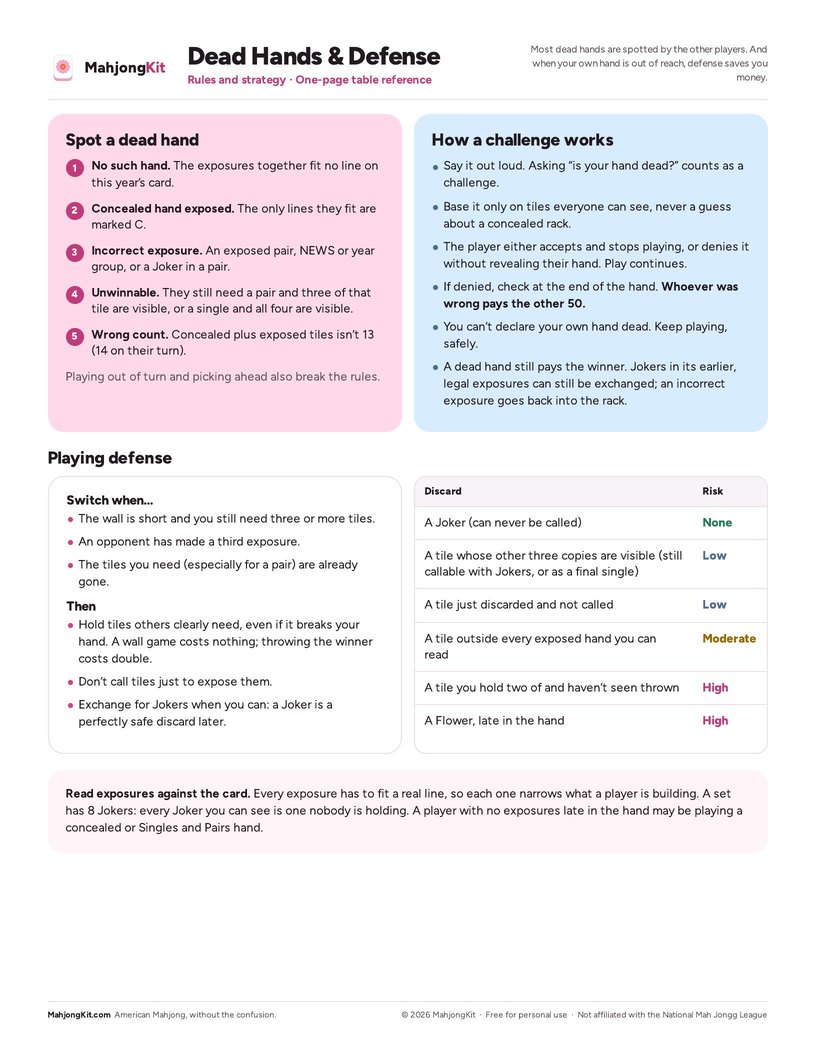
Dead hands and defense card
One page: five ways to spot a dead hand, how a challenge works, when to switch to defense, and a ladder of safer and riskier discards.
What is the safest discard in American Mahjong?
A Joker. Once discarded, a Joker is dead and cannot be called by anyone for an exposure or for Mahjong.
Is a tile safe if three of it are already showing?
Safer, but not safe. Nobody can make a natural pair or pung from it, but a player can still claim it with Jokers for a pung or kong, or use it as the single tile that completes their hand.
When should I stop trying to win and play defense?
When the wall is short and you still need several tiles, when an opponent has three exposures, or when the tiles you need are already gone.
What is a hot tile in Mahjong?
A tile another player appears to need, judging by their exposures and discards. Hold hot tiles when you are defending.