Quick answerTeach in small tables of four, over four weekly sessions of about two hours: tiles and setup, then the card, then the Charleston and calling, then full games with scoring. Price by the session or the full course, and hold classes wherever you can get a quiet table: your home, a library, a community center or a café.
On this page
American Mahjong is booming, and many new players would rather learn in a class than piece the game together from videos. If you know the game well and enjoy explaining it, teaching is a rewarding way to grow your local Mahjong community, and it can earn you some money too.
Who this guide is for
This guide is for anyone who wants to run structured lessons: a paid beginner course, a class at a library or community center, or a series of lessons for a group of friends. If you are teaching one friend on a game night, you want Teach a Beginner instead.
Teaching Mahjong doesn't require a formal certification. What students care about is a teacher who knows the rules, explains them clearly and stays patient. If you can play a full game without looking anything up, and you can explain why a hand is dead, you are ready to teach.
The class format
- Four students per table. Mahjong is a four-player game, so students learn fastest at a full table.
- One or two tables per teacher. With more than eight students, you can't watch every rack.
- Four weekly sessions of about two hours. Weekly spacing gives students time to study the card between lessons.
- Play in every session. Keep explanations short and get tiles moving early. Students learn by doing.
The four-week course
This plan comes from a working instructor’s course. Each session runs about two hours: a short block of new material, then guided play that grows longer each week as students need you less.
- Week 1: Tiles, the card and the basic flow.
Tile tour (15 minutes): spread the tiles out and have students sort them into suits, Winds, Dragons, Flowers and Jokers. The card (30 minutes): colors mean how many suits, not which suits; walk through one simple section. Walls (20 minutes): wash and build walls 19 stacks long and two high. Open-hand play (45 minutes): skip the Charleston, deal 13 tiles (14 to East), and narrate draw, assess, discard. Send students home with the tiles guide and ask them to order their own card.
- Week 2: The Charleston and choosing a hand.
Sorting the rack (15 minutes): pairs first, then suits in order, then Winds and Dragons. The Charleston (30 minutes): the required first Charleston, the optional second, and the courtesy pass. The blind pass (15 minutes). Assisted play (60 minutes): two full hands with racks open during the Charleston so you can coach every pass. See the Charleston guide.
- Week 3: Calling discards and Jokers.
Groups (15 minutes): pung, kong, quint and sextet. Calling (20 minutes): call out loud, expose the group face up on top of the rack, then discard. Jokers (25 minutes): groups of three or more only, and how to exchange for a Joker on your turn. Semi-closed play (60 minutes): racks hidden, stepping in only when asked. See the Joker rules.
- Week 4: Concealed hands, dead hands and a graduation game.
Concealed hands (15 minutes): the C on the card. Dead hands (20 minutes): wrong tile counts, impossible exposures and illegal Jokers; see dead hands. Scoring (15 minutes): hand values, double payouts and the Jokerless bonus; see scoring and payouts. Graduation game (70 minutes): students play on their own, and you step in only when a rule is broken, not to correct strategy.
Teaching tipEvery new rule should be followed within minutes by students using it at the table. A rule explained and then practiced the following week is usually a rule forgotten.
Teaching the card in 30 minutes
The card is the most intimidating thing a beginner sees. Break it into four ideas, from the biggest to the finest print, and never try to explain point values first.
- The color formula (10 minutes). Colors do not stand for particular suits. One color means one suit, two colors mean two suits, three colors mean three suits. Drill it: “If the red numbers are Bams and the green are Dots, what must the blue numbers be?”
- Letters and Dragons (5 minutes). N, E, W, S are Winds, F is a Flower, D is a Dragon, and a 0 is Soap. Then the Dragon pairings, with memory tricks: Green Dragon with Bams (bamboo is green), Red Dragon with Craks (the character on a Crak is usually printed in red), Soap with Dots (soap makes round bubbles).
- Groups and the Joker rule (7 minutes). Pair, pung, kong, quint, sextet. Then the one rule that matters most: Jokers only in groups of three or more, never in a single or a pair. Point out that a year hand such as 2026 is made of singles and a pair, so no Jokers there.
- The small print (8 minutes). Parentheses often add flexibility, such as “any run” or “any suit.” X means the hand may be exposed by calling discards; C means concealed, with no calling except for the final Mahjong tile.
Finish by dealing each student a hand and giving them five minutes to find two lines on the card they could aim for. Use your own examples on a whiteboard rather than copying lines from the card, which is copyrighted.
Teaching the Charleston
The passing rules are mechanical, but deciding what to pass is abstract for a new player. Control the pace and keep everything visible.
- Open racks for the first two games. With tiles face up you can see every pass and explain why it is good or bad before it happens.
- Sort before passing. Pairs to one end, then each suit in order, then Winds and Dragons. Whatever connects to nothing is the first thing to pass.
- A mnemonic. Some teachers use ROLLOR: Right, Over, Left for the first Charleston; Left, Over, Right for the second.
- Stop at the halfway point. Pause after the first Charleston and ask whether anyone wants to stop. Any one player can stop the second Charleston.
- Explain the blind pass at the moment it applies, on the first Left and the last Right, not at the start.
- Coach defensive passing. A good pass is a “salad” of unrelated tiles. Stop a student who is about to pass a pair or three consecutive numbers in one suit.
- The Joker rule, with eye contact. Hold up a Joker: it can never be passed, in any pass, including the courtesy.
Our free Charleston quick card covers the sequence on one page for students to take home.
What students need
- Their own card. Every student needs the current National Mah Jongg League card. Ask them to order it directly from the League. Don't photocopy cards for students: the card is copyrighted, and every player is expected to buy their own.
- A set for each table. Most teachers supply the sets, racks and mats. See our guides to tiles and gear before you buy extra sets for a class.
- Something to take home. Our free printable table companion is made for beginners and can be printed for every student.
How much to charge
As a ballpark, plan on about $40 per student per session for a group class. Rates vary by area, so check what community education programs and other teachers near you charge, then adjust your number for four things:
- Your time, including setup, travel and preparation, not just the two hours at the table.
- Venue costs, whether that is rent, a room fee or an agreement that students buy food and drinks.
- Supplies, such as sets, mats, printed handouts and their eventual replacement.
- Group size. A full table of four brings in four times a single student's fee for the same session.
Two common ways to structure it:
| Model | How it works | Good for |
|---|---|---|
| Per student, per session | Each student pays for each lesson they attend | Drop-in classes and trial lessons |
| Four-week package | Students pay once for the whole course | Committed groups; students are more likely to finish |
| Private group lesson | A flat fee for a group of friends, often in someone's home | Friends who want to learn together |
The math is simple: fee per student multiplied by students, minus venue and supply costs, equals what you earn for the session. At the $40 ballpark, one full table of four brings in $160 for a two-hour session before costs, and a four-week course for that table brings in $640. Two tables double it.
If you teach regularly for money, it is worth keeping simple records of what you earn and spend, and checking your local rules on side income.
Where to teach
- Your home. Free and comfortable, and good for one table. Best for private groups.
- Libraries and community centers. Many have rooms for community programs. Ask whether paid classes are allowed, or offer a free introductory session that feeds your paid course.
- Cafés and coffee shops. Many welcome a group during quiet hours, especially if everyone buys a drink. Ask the manager directly and suggest a regular time slot.
- Places of worship, JCCs and senior centers. Many already host Mahjong groups and look for teachers.
- Adult education programs. Community colleges and recreation departments run classes and handle registration and payment. You teach and get paid per course.
- Clubs. Country clubs, tennis clubs and neighborhood associations often want member activities.
When you approach a venue, keep the pitch short: who you are, what you want to run, how many people it brings in and when, and what it costs them. A regular group of eight people every week is an easy yes for many cafés.
Finding students
- Start with your own circle. Your first class is usually friends of friends.
- Post locally. Neighborhood apps, local Facebook groups, library and community boards.
- Offer a free taster. A one-hour "What is American Mahjong?" session fills the paid course.
- Ask graduates for referrals. Happy students are the best marketing, and they usually have friends who want to learn.
After the course: start a club
The hardest moment for a new player is the week after the course ends, with no one to play with. Give graduates somewhere to go: a weekly open-play session at the same venue. It keeps your students playing, gives newer students a place to practice, and turns a course into a community. Hosting a game night covers the practical side.
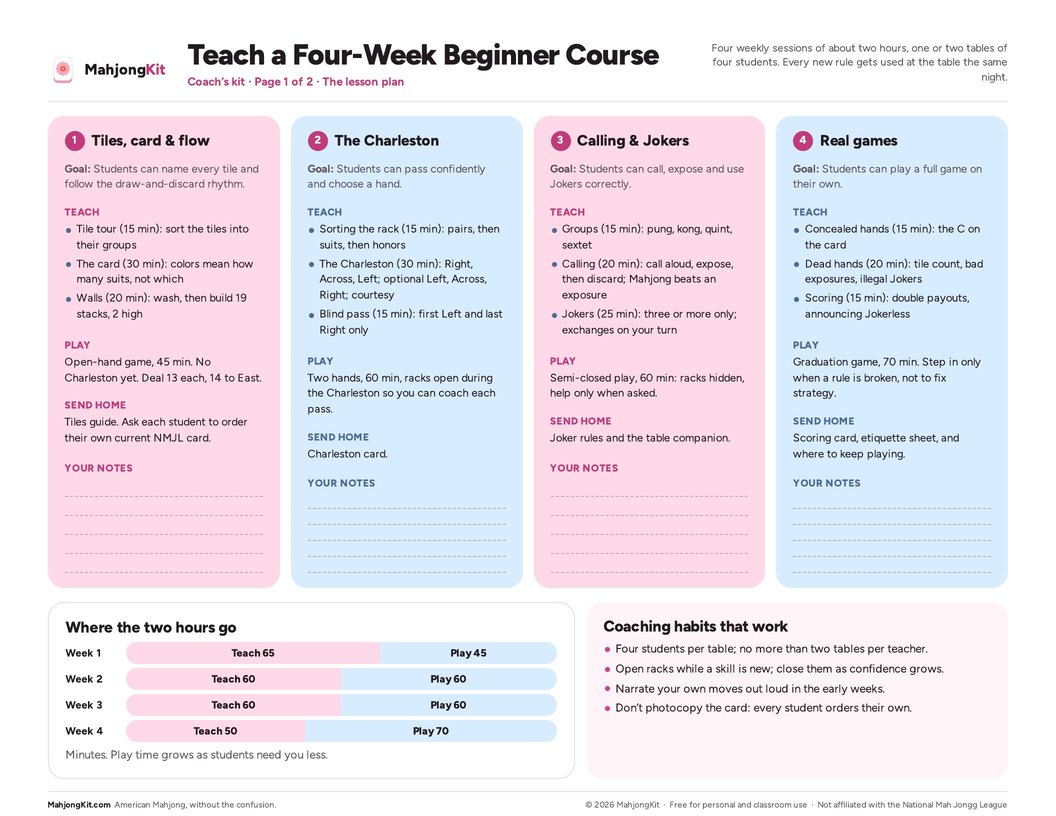
Coach's kit: a four-week course
Two pages for teachers: the week-by-week lesson plan with space for notes, a session timeline, a pricing worksheet, supply and venue checklists, and a roster.
Do I need to be certified to teach Mahjong?
No formal certification is required. Students care about a clear, patient teacher who knows the rules well.
How many students can one teacher handle?
One or two tables of four. Beyond eight students, it is hard to watch every rack.
How much should I charge for Mahjong lessons?
About $40 per student per session is a reasonable ballpark for a group class. Adjust it for your area, your venue costs and whether you supply the sets.
How long does it take to learn American Mahjong?
Most beginners can play a slow game on their own after about four lessons. Getting comfortable with a new card each year takes regular play.
Can I copy the NMJL card for my students?
No. The card is copyrighted. Ask each student to order their own from the National Mah Jongg League.
Should I teach with a practice card?
You can use a free practice card for the first lesson or two, but move students to the current NMJL card quickly, since that is what they will play with.