Quick answerEach player starts with 13 tiles, and East (the dealer) starts with 14. Walls are 19 stacks long and two tiles high, because an American set has 152 tiles.
On this page
What you need
- An American Mahjong set: 152 tiles including 8 Jokers (most sets add blank spares)
- Four racks, ideally with pushers
- Two dice
- A current NMJL card for each player
- A square table, and ideally a mat to quiet the tiles
If you are still choosing equipment, our set buying guide explains what to look for.
1. Wash the tiles
Turn all 152 tiles face down in the middle of the table. Everyone uses both hands to swirl them around for fifteen or twenty seconds. This is the wash, and the clatter is part of the game's charm. Keep going until nobody could possibly know where any tile is.
2. Build the walls
Each player builds one side of a square in front of their own rack.
- Lay a row of 19 tiles
Slide face-down tiles from the middle into a straight line in front of your rack until it is 19 tiles long.
- Stack a second row on top
Build a second row of 19 and lift it onto the first. Your wall is now 19 stacks long and two tiles high.
- Push the wall forward
Use the pusher on your rack (or your hands) to slide the wall toward the center so the four walls form a square.
All 152 tiles are now in the walls (4 × 19 × 2 = 152). If a wall is short or long, count and fix it before rolling.
Different game, different wall. In traditional Chinese Mahjong the set has 144 tiles, so walls are 18 stacks long. If you sit down at a table with 18-stack walls, you are probably not playing American rules. See Chinese vs. American Mahjong.
3. Choose East (the dealer)
The dealer is called East. For the first hand, each player rolls both dice and the highest total becomes East. After that, East usually passes to the right after each hand, though many groups let the winner or a fixed rotation decide. East has a small edge: they roll to break the wall and begin with 14 tiles.
4. Break the wall
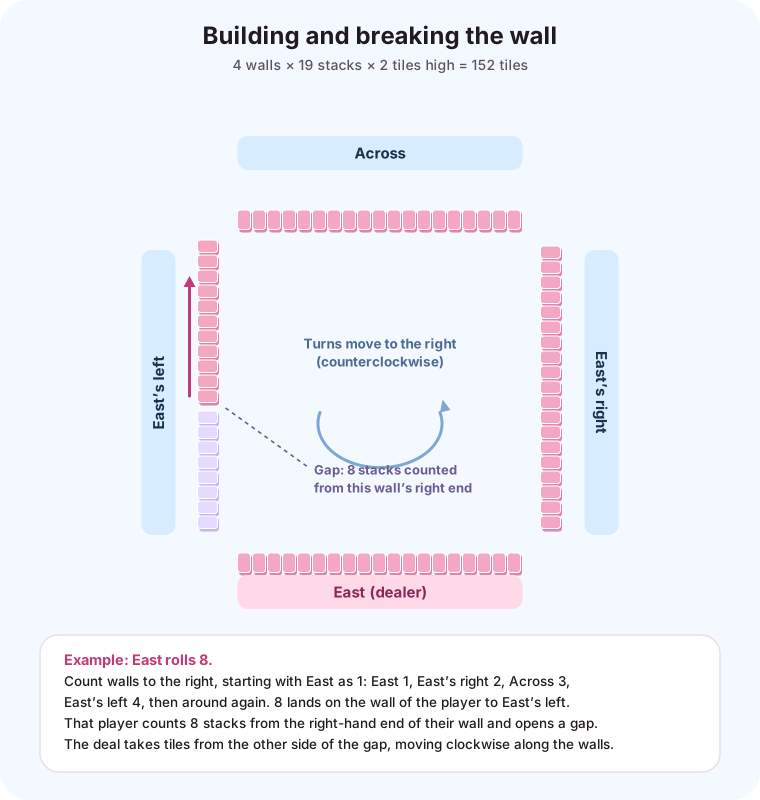
East rolls both dice again. The total tells the table two things: whose wall to break, and where to break it.
- Count walls to the right
Starting with East's own wall as 1, count counter-clockwise (East, then the player on East's right, then across, then left) up to the number rolled. A roll of 8 lands on the wall of the player to East's left.
- Count stacks from the right
The owner of that wall counts that same number of stacks from the right-hand end of their wall and opens a gap after it.
- Deal from the gap
Tiles are taken starting from the left side of the gap and continuing along the wall. When one wall is used up, drawing continues from the next wall in the same direction.
5. Deal the tiles
East takes the first two stacks (four tiles). The player to East's right takes the next two stacks, then the player across, then the player to East's left. Go around three times so that everyone has 12 tiles.
Then the final pick: East takes two more tiles (traditionally the top tiles of the first and third remaining stacks), and each of the other three players takes one. East now has 14 tiles and everyone else has 13.
Rack your tiles, keep them hidden, and move straight into the Charleston. During play, East discards first to bring their hand down to 13, and each turn afterwards is draw one, discard one.
Beginner tipCount your tiles the moment the deal ends and again after the Charleston. A wrong tile count is the most common way a beginner ends up with a dead hand.
Setup questions
How many tiles does each player start with?
13 tiles. East, the dealer, starts with 14 and discards first.
How long is an American Mahjong wall?
19 stacks long and two tiles high on each of the four sides, for 152 tiles total.
Who starts as East?
For the first hand, whoever rolls highest with two dice. Groups vary on how East moves after that; passing to the right each hand is common.
Which direction does play go?
Counter-clockwise: after East comes the player on East's right.
Can you play American Mahjong with three players?
Yes, with house rules. Common adjustments include leaving one wall's tiles in reserve and adapting the Charleston (across passes have no partner, so they are skipped or swapped for a different pass). There is no single official three-player standard, so agree the rules first.
Official rules note. This guide explains American Mahjong as it is commonly played with the National Mah Jongg League card. House rules and tournament procedures can vary. For the official wording, use the current card and rulebook from the National Mah Jongg League. MahjongKit is not affiliated with the League.