Quick answerA hand is dead when it can no longer legally win, usually because of a structural mistake: the wrong number of tiles, an exposure that matches no hand on the card, a Joker in a pair or single, or a false Mahjong call. You stop playing for the rest of that hand but stay at the table.
On this page
Hearing "your hand is dead" for the first time stings, but it is a normal part of learning American Mahjong. The rules about how you build and expose a hand are strict, so mechanical slips carry a real penalty. Once you know the common causes, they are easy to avoid.
What a dead hand means
When your hand is declared dead, you are out of the current round. You stop drawing, you stop discarding, and you cannot win. You do not sweep your tiles into the middle. They stay on your rack exactly as they are, and you stay seated because you may still owe the winner at the end (if your group plays for stakes). The other players carry on without you.
The five common causes
1. The wrong number of tiles
You should hold 13 tiles, or 14 during your turn after you draw and before you discard. If another player notices you have 12 or 15, your hand is dead. The usual causes are forgetting to discard after a draw, or a tile slipping off the table unnoticed. Count your tiles after the Charleston and any time a turn feels muddled.
2. An impossible exposure
If you call a discard and expose a group that cannot fit any hand on the current card, your hand is dead. For example, if you expose a kong of a tile that appears only as a pung or a pair on this year's card, there is no path to a legal win. Before you call, check that the exposure fits at least one hand you could still complete.
3. Exposing on a concealed hand
Hands marked C on the card must be played concealed: you cannot call discards to build them (the one exception is calling the final tile for Mahjong). If you expose a group and the only hand it could possibly belong to is a concealed hand, your hand is dead. Our guide to reading the card explains the X and C marks.
4. Illegal Joker use
Jokers only work in groups of three or more. Expose a pair with a Joker in it, or use a Joker as a single, and the hand is dead immediately. See the full Joker rules.
5. A false Mahjong
If you declare Mahjong, show your hand, and it turns out not to match a line on the card exactly, your hand is dead and play continues among the others. Be careful here: if another player exposes their own hand in reaction to your call before the mistake is caught, that player's hand is usually dead too. Never show your tiles until you have personally checked the winner's hand against the card.
Rules warningSome groups treat a false Mahjong call more strictly than a normal dead hand, especially in tournaments. Ask about house rules before you play for stakes.
Spotting a dead hand across the table
Most dead hands are found by the other players, not the one who made the mistake. These are the checks worth running whenever someone makes an exposure:
- Do the exposures fit any line?
After a second or third exposure, look for a single hand on this year’s card that uses all of those groups together. If there is none, the hand is dead.
- Is it a concealed hand?
If the only lines the exposures could belong to are marked C, the player exposed a hand that had to stay concealed.
- Is the exposure legal?
Only pungs, kongs, quints and sextets can be exposed before Mahjong. An exposed pair, a NEWS, a year grouping, or a Joker used in a pair is an incorrect exposure.
- Can the hand still be finished?
If a player’s exposures mean they still need a pair, and three of that tile are already visible in discards and exposures, the pair is impossible. The same goes for a needed single once all four copies are visible. That hand is unwinnable.
- Is the tile count right?
Concealed tiles plus exposed tiles should make 13, or 14 during that player’s turn.
Playing out of turn, picking a tile from the wall before your turn (picking ahead) and picking from the wrong wall are also against the rules and can cost a player their hand.
Who can declare a hand dead
Any player at the table can challenge a hand. The challenge has to be said out loud so everyone hears it; you cannot quietly decide a hand is dead and keep playing. The challenged player either accepts it and stops playing, or denies it without revealing which hand they are making, and play continues. At the end of the hand, the tiles are checked. Under the League's published rulings, whoever turns out to be wrong pays the other player 50 (the challenger if the hand was alive, or the challenged player if it really was dead). So only challenge when you are sure.
- Base it on what everyone can see. Exposures, discards and a visible tile count are fair grounds. A guess about someone’s concealed tiles is not.
- A question counts. Asking out loud whether someone’s hand is dead is treated as a challenge.
- You cannot declare yourself dead. If you realize your own hand can’t win, say nothing and keep playing, discarding safely, until another player notices. See defensive play.
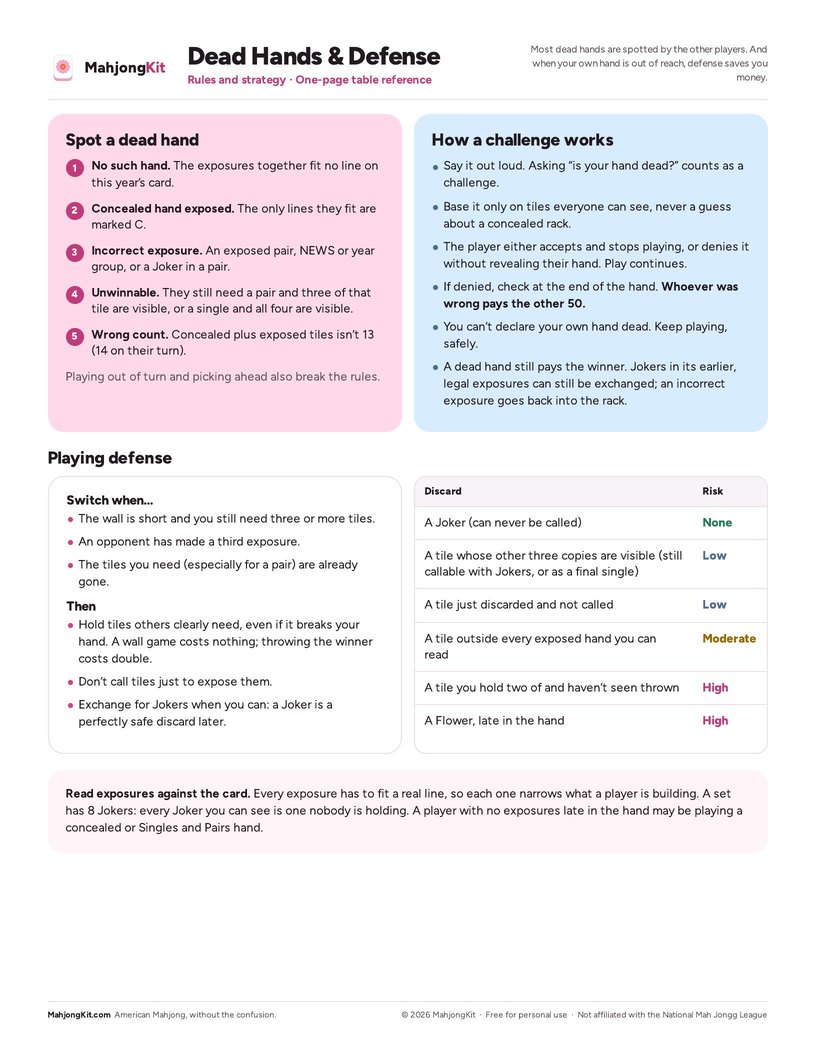
Dead hands and defense card
One page: five ways to spot a dead hand, how a challenge works, when to switch to defense, and a ladder of safer and riskier discards.
What happens to your tiles and Jokers
- Legal earlier exposures stay on top of your rack. Other players can still exchange Jokers out of them.
- The exposure that killed the hand comes off. Those tiles go back into the sloped part of your rack, and nobody can exchange a Joker from that group.
- Concealed-hand errors return everything. If you exposed tiles while building a concealed hand, all exposures go back into the rack and none of those Jokers can be exchanged.
Habits that keep your hand alive
- Count to 13 after the Charleston, and again whenever play gets hectic.
- Before calling a discard, put your finger on the exact line of the card the exposure fits.
- Say "pair" to yourself whenever you consider using a Joker. If the answer is "pair", put the Joker down.
- When someone calls Mahjong, look before you touch your own tiles.
Beginner tipNew players sometimes freeze after a dead hand. Use the time to watch what the other three are collecting; you will learn more about card strategy from one dead hand than from three uneventful wins.
Official rules note. This guide explains American Mahjong as it is commonly played with the National Mah Jongg League card. House rules and tournament procedures can vary. For the official wording, use the current card and rulebook from the National Mah Jongg League. MahjongKit is not affiliated with the League.