Quick answerThe winner collects the value printed next to their hand on the card. On a discarded tile, the player who threw it pays double and the other two pay single. On a self-drawn tile, all three pay double. A Jokerless hand doubles every payment, except Singles and Pairs hands.
On this page
Scoring in American Mahjong is much simpler than in Chinese styles. There is no counting of points across the hand and no bonus for the dealer. Only the winner is paid, and the amount depends on three things: the hand's value, how the winning tile arrived, and whether the hand used any Jokers.
Where the values come from
Every hand on the card has a value printed beside it, usually between 25 and 50. Harder hands are worth more. Concealed hands, which you must build without calling discards, tend to be worth more than exposed versions of similar hands.
Groups that play for money usually treat the value as cents, so a 25 hand is worth a quarter. Plenty of groups skip money entirely and keep a running tally instead.
The payout rules
Only the winner gets paid. Who pays how much depends on where the winning tile came from:
| How the hand was won | Who pays what |
|---|---|
| Called a discard for Mahjong | The player who discarded it pays double the value. The other two pay the value. |
| Drew the winning tile from the wall (self-drawn) | All three players pay double the value. |
| Jokerless, on a discard | The player who discarded it pays four times the value. The other two pay double. |
| Jokerless, self-drawn | All three players pay four times the value. |
A few details to know:
- Jokerless means no Jokers anywhere in the winning hand, whether in your concealed tiles or your exposures.
- Singles and Pairs hands never get the Jokerless bonus. Jokers cannot be used in singles or pairs, so these hands are always Jokerless, and their card value already reflects that.
- Quint hands don't get it either. A quint almost always needs a Joker, and the card value already allows for the difficulty.
- Announce it. Say "Jokerless" when you declare Mahjong. The League has ruled that a player who doesn't announce it isn't entitled to the bonus.
- There is no dealer bonus. Unlike some Chinese styles, East neither pays nor collects extra.
Worked examples
Say you win with a hand valued at 25 on the card.
| Situation | What each player pays you | Your total |
|---|---|---|
| North discards your winning tile | North pays 50, the other two pay 25 each | 100 |
| You draw the winning tile from the wall | Everyone pays 50 | 150 |
| Jokerless, North discards your tile | North pays 100, the other two pay 50 each | 200 |
| Jokerless, self-drawn | Everyone pays 100 | 300 |
This is why experienced players think twice before discarding a tile an opponent might need late in the game: throwing someone their winning tile costs you double.
When nobody wins
If the wall runs out before anyone declares Mahjong, it is a wall game. Nobody wins and nobody pays. The tiles are washed and the next hand is dealt. Some groups keep a small kitty that grows with each wall game; that is a house rule, so agree on it before you start.
Dead hands and false Mahjong calls
A player whose hand has been declared dead stops playing but still pays the winner at the end of the hand.
Challenging a hand as dead carries its own small stake. If a player denies a challenge, the hand is checked at the end, and under the League's published rulings whoever was wrong pays the other 50.
Calling Mahjong by mistake is more serious. The caller's hand is dead. If the call caused other players to expose or mix their tiles, the League's rules set out a penalty for the player who called in error. Groups handle this differently in casual play, so agree how yours will treat it before the first hand. The simplest prevention is the same at every table: everyone checks the winning hand against the card before anyone touches their tiles or pays.
Playing for money or for points
- Set stakes before the first wall is built. Agree whether you are playing for money, how much each point is worth, and whether you use any house rules such as a kitty.
- Keep it small. Most social groups play for small change. Some start everyone with the same amount and stop when a player runs out.
- Keep a tally instead. A pencil and a scorecard work just as well, and suit groups that would rather not handle money.
- Beginners can skip scoring. For the first few games, just learn to win. See how to teach a beginner.
Table rules that aren't official
Many groups add rules that you won't find on the card. They are fine as long as everyone agrees before play:
- Pie. Each player brings a set amount, often in coins. Once it is gone, that player keeps playing but can't lose any more.
- Kitty. Players pay into a pot after a wall game, and the next winner collects it.
- Hot wall, cold wall and "paying for the party". Extra penalties or restrictions on throwing a winning tile late in the hand. Under the official rules there is no such penalty: the discarder always pays double, no more.
Tournaments use their own points systems, with bonuses and penalties set by the organizer. Follow the event's rules sheet rather than home-game habits.
Quick reference
Payouts in one glanceDiscard: thrower pays 2x, others 1x. Self-drawn: everyone pays 2x. Jokerless (announced; not Singles and Pairs or Quints): double all of the above. Wall game: nobody pays. Dead hand: still pays the winner.
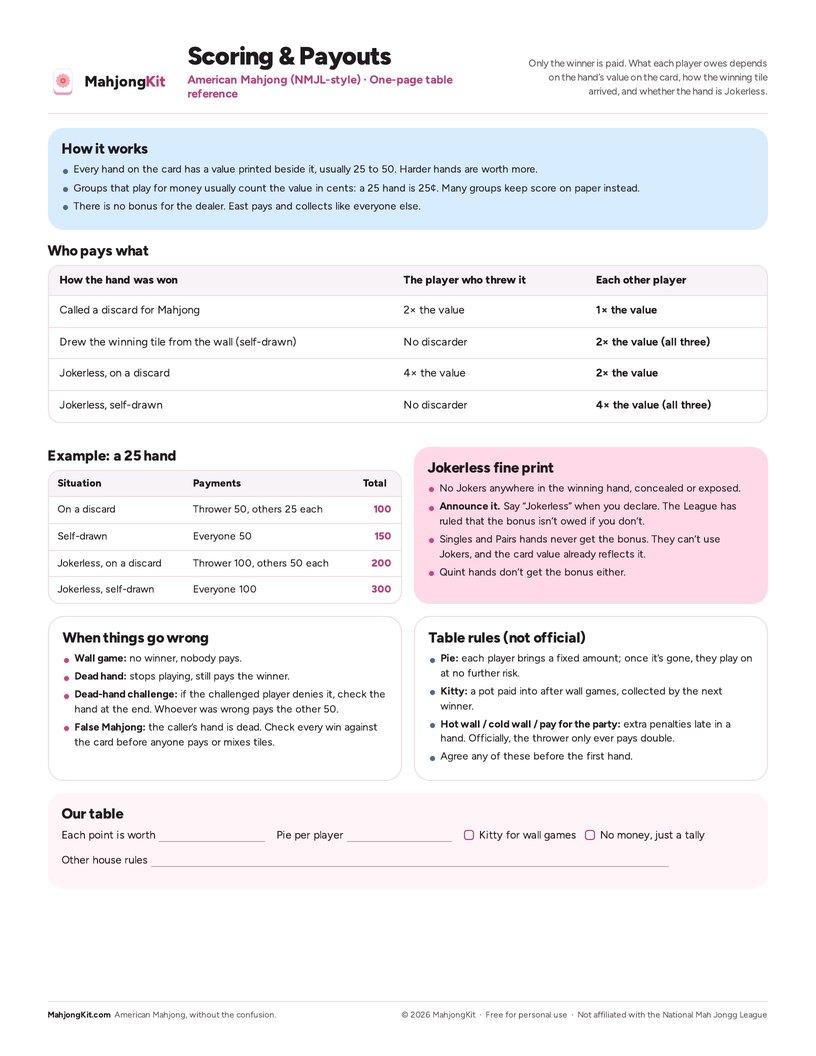
Scoring and payouts card
One page: who pays what, a worked example, the Jokerless fine print, what happens when things go wrong, and a spot to write your table's stakes.
Who pays double in American Mahjong?
The player who discarded the winning tile pays double. If the winner drew the tile from the wall, all three players pay double.
How does Jokerless scoring work?
A hand completed without any Jokers is worth double, so every payment doubles, as long as you announce it when you declare. Singles and Pairs hands and Quint hands do not get the bonus.
Does East pay or collect double?
No. In American Mahjong the dealer has no special payout.
What happens to money in a wall game?
Nothing changes hands unless your group plays a kitty as a house rule.
Does a dead hand still pay?
Yes. A player with a dead hand stops playing but still pays the winner.