Quick answerAgree the house rules before you start, name every discard clearly, call tiles promptly, wait your turn before you draw, keep your hand and your advice to yourself, and let everyone check a Mahjong before anyone touches their tiles.
On this page
Most of what makes a Mahjong table pleasant is not written on the card. Every group has habits, and a new player who follows them fits in immediately. These are the conventions you will find at most American Mahjong tables, along with the few official rules they grew out of.
Before the first hand
Talk through the things groups do differently before any tiles move. It takes two minutes and prevents nearly every argument later.
- Stakes. Money, a tally, or nothing at all. See scoring and payouts.
- Charleston options. Whether you play the optional second Charleston and courtesy pass, and whether blind passes are allowed.
- Misnamed discards. What happens if someone names a tile wrong and another player calls it.
- Coaching. Whether it is a learning game with open advice, or a regular game where everyone plays their own hand.
- Bring your own card. Every player should have the current year's card. Sharing one slows the game and exposes your plans.
Discarding
- Name every discard out loud, clearly, as you place it face up in the middle: "Three Bam", "North", "Soap". A silent discard cannot fairly be called.
- Place it; don't throw it. Tiles set down gently stay visible and stay unchipped.
- A discard is final as soon as it touches the table or you have fully named it, whichever comes first. You cannot take it back.
- Correct a misname immediately. If you said "Four Dot" and threw the Five, say so right away. Groups differ on what happens if someone calls the misnamed tile, which is why it is worth agreeing in advance.
Calling tiles
- Call out loud, promptly. Say "call" (or the tile's name) before the next player racks their drawn tile, discards or exchanges a Joker. After that, the discard is gone. If the next player has drawn but not yet racked, they put the tile back on the wall.
- Never pick ahead. Taking or peeking at a wall tile before your turn is against the official rules, not just bad manners.
- Pause a beat before you draw. Grabbing and racking the instant a discard lands gives nobody time to call it. The League has said that racing to shut other players out is poor sportsmanship.
- Know the priority. A call for Mahjong beats a call for an exposure. If two players call for the same thing, the one next in turn after the discarder gets the tile, unless the other player has already started exposing.
- Expose before you discard. When you call a tile, place the complete group face up on your rack, then discard. A group you expose has to fit a hand on the card, or your hand is dead.
- No calling for pairs. You can only call a discard for a pung or larger group, or for the last tile you need for Mahjong.
On your turn
- Touch only the wall and your own rack. Don't straighten other players' racks, and don't peek at the wall.
- Joker exchanges happen on your turn, after you have drawn or made an exposure and before you discard. Hand the natural tile to the Joker's owner rather than putting it on the table. See the Joker rules.
- Keep count. Thirteen tiles, or fourteen after you draw. Counting quietly each turn is the cheapest insurance against a dead hand.
Table talk
Conversation is half the fun of Mahjong. Talk about your hand is not.
- Don't announce what you need or what you are building.
- Don't react to discards. "You threw my tile!" tells the whole table what you are collecting.
- Don't coach in a regular game unless everyone has agreed to it. In a learning game, coaching is the point.
- Don't comment on someone else's play after the hand, unless they ask.
Declaring Mahjong
- Say "Mahjong" clearly when you take the winning tile, then expose your whole hand, arranged in card order so others can check it. Say "Jokerless" too if it is.
- Let everyone check it. Other players should keep their own tiles on their racks until the hand has been checked against the card. Mixing tiles before then makes an error impossible to sort out.
- Pay promptly once the win is confirmed, and keep small change within reach if you play for money.
Pace
A steady rhythm keeps four people happy. Think during the Charleston and while others take their turns, so your own turn is quick. If you are new and need more time, say so at the start. Every good table will slow down for a beginner who asks.
The social side
- Keep food and drinks off the table, and wash sticky hands before you touch the tiles. See hosting a game night for snacks that work.
- Phones away during a hand, unless you are the one waiting on a call.
- Be kind to beginners. Everyone at the table was one once. A patient first game is how groups grow.
- Help wash and build. Everyone washes the tiles and builds their own wall.
When there is a dispute
Stop, check the card, and apply whatever house rule you agreed at the start. If the question is genuinely unclear, go with the host's call and look it up after the game rather than arguing through the next hand. For official play, the National Mah Jongg League's card and published rules are the final word.
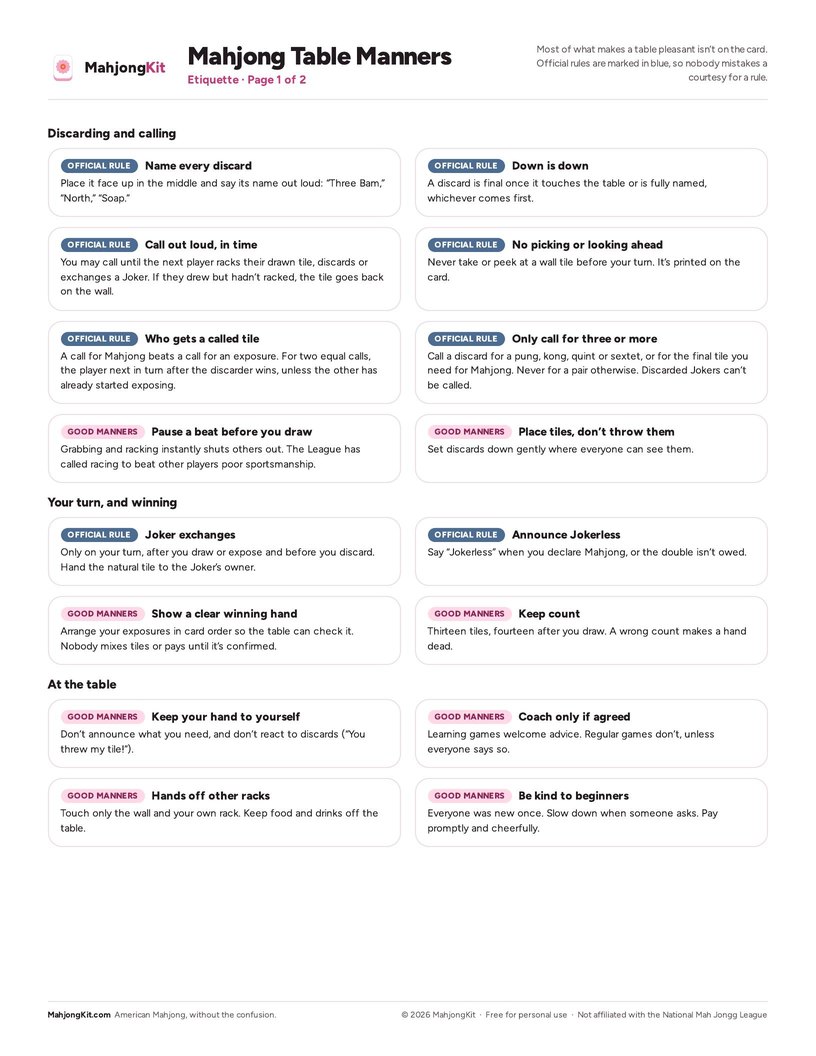
Table manners and house rules
Two pages: table etiquette with every official rule marked, plus a fill-in house-rules sheet your group can agree and sign before play.
Do you have to name your discard in Mahjong?
Yes. Name every discard out loud as you place it face up in the middle of the table.
Can you take back a discard?
No. A discard stands as soon as it touches the table or has been fully named.
How long do you have to call a discard?
Until the next player racks their drawn tile, discards or exchanges a Joker. Call promptly and out loud.
What is picking ahead?
Taking or looking at a wall tile before your turn. It is against the official rules. Separately, it is good manners to pause a beat after each discard before you draw, so others have time to call it.
Can you talk during Mahjong?
Yes, just not about your hand. Chat freely, but don't announce what you need or react to other players' discards.