Quick answerFirst Charleston: pass three tiles right, then three across, then three left. If all four players agree, a second Charleston goes left, across, right. Then an optional courtesy pass across. You always pass exactly three (except in a blind pass or courtesy pass), and you can never pass a Joker.
On this page
A lot of American Mahjong is decided before anyone draws from the wall. The Charleston turns thirteen random tiles into the start of a hand, and it is also where beginners feel the most pressure: everyone is waiting, the card is enormous, and you have to give three tiles away right now. This page slows it down.
The passing sequence
First Charleston (required)
- →RightPass 3 to the player on your right
- ↔AcrossPass 3 to the player opposite
- ←LeftPass 3 to the player on your left · blind pass allowed
Second Charleston (only if all four agree)
- ←LeftPass 3 to your left
- ↔AcrossPass 3 across
- →RightPass 3 to your right · blind pass allowed
Stage 1: the first Charleston
Everyone must take part. Each of the three passes works the same way: choose three tiles you do not want, place them face down, and slide them to the receiving player at the same time as you receive three from the other side. Look at what arrived, then choose three for the next pass. You can pass on tiles you just received.
- First right
Three tiles to your right. You receive three from your left.
- First across
Three tiles to the player opposite. You receive three from them.
- First left
Three tiles to your left. You receive three from your right. This is the first pass where a blind pass is allowed.
Stage 2: the second Charleston
After the first Charleston, any player may stop. If even one player says "stop", there is no second Charleston and play moves to the courtesy pass. If all four agree to continue, the direction reverses:
- Second left
Three tiles to your left.
- Second across
Three tiles across.
- Second right
Three tiles to your right. A blind pass is allowed here too.
Stage 3: the courtesy pass
Once passing is over, you and the player across from you may agree to swap one, two or three tiles. Both players must want the same number: if you offer two and they offer one, you swap one. No blind passing, and no Jokers.
Rules warningYou may never pass a Joker during any part of the Charleston or the courtesy pass. If a Joker arrives in a pass, the passer has made a mistake and the tiles should be sorted out before play continues. Many groups treat a passed Joker as a dead hand for the passer.
The blind pass
On the last pass of each Charleston (first left and second right), you may take one, two or three of the tiles being passed to you on that same pass and send them straight on without looking at them. The point is to protect a hand that is already coming together: if you only have one tile you can spare, blind pass two of the incoming tiles and add your one, and you have met the three-tile requirement without breaking anything up.
Two details. First, you must still pass three tiles in total. Second, a blind pass is a "steal" from the incoming tiles only, not from the wall or your own hand.
Beginner tipYou do not have to announce a blind pass, but many players say "blind" or "passing blind" as a courtesy. It is worth asking how your group does it.
How to pick a hand during the Charleston
- Start with your pairs. Jokers can fill pungs, kongs, quints and sextets, but never pairs. So the natural pairs you are dealt decide which lines on the card are realistic. Build around them.
- Aim at a section, not a line. Lots of evens? Consecutive numbers? Winds and Dragons? Commit to the section, and let the incoming tiles choose the specific line.
- Find your passers first. Unconnected singles, a lone Wind, a 9 when everything else is low. Those go first, and they go in the first right pass while you are still learning your hand.
- Re-read the card after every pass. Three new tiles can move you to a neighboring line. This is normal and good.
Defensive passing: what not to give away
Every tile you pass builds someone else's hand, so pass in a way that helps them as little as possible.
- Never pass a pair. Two identical tiles to one player hands them a pair (which Jokers cannot make) or the start of a pung. Split identical tiles across different passes.
- Avoid passing related tiles together. Not 1, 2 and 3 of a suit; not East, West and South in one pass.
- Pass a "salad". Three unrelated tiles, such as a North, a 2 Bam and a 9 Dot, give the receiver very little to work with.
- Flowers are low-risk to pass early unless you are collecting them, because they are interchangeable and plentiful. Later in the Charleston, hold them until you know what your neighbors are doing.
When to stop the second Charleston
Stop if your hand is already strong after the first Charleston and further passing would only give your opponents more chances. Continue if you are still far from a line and need more tiles to move. Stopping is a right, not an insult, and experienced players use it without apology.
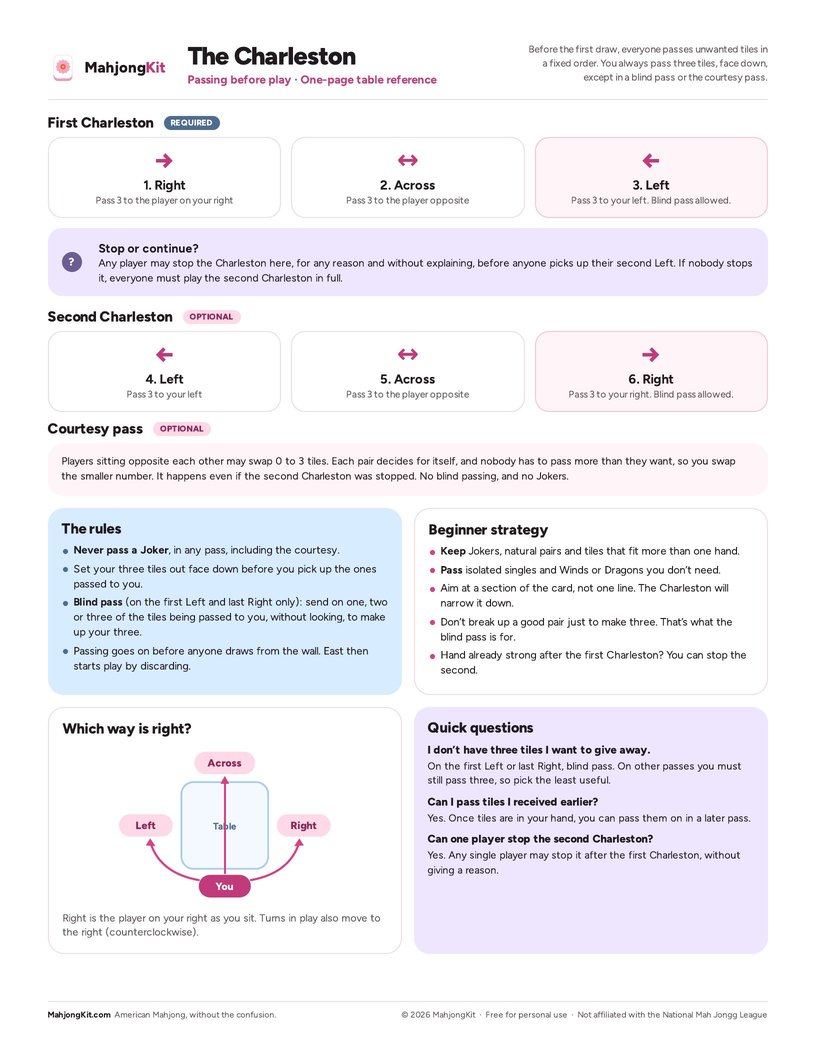
The Charleston quick card
One page: every pass in order, where you can stop, the blind pass and courtesy pass, a seat diagram, and beginner strategy.
Charleston questions
What is a blind pass?
On the last pass of either Charleston, taking one to three of the tiles you just received and passing them on unseen. You still pass three tiles in total.
Can you pass a Joker in the Charleston?
No, never. Jokers stay in the rack.
Can the second Charleston be stopped?
Yes. Any single player can stop it after the first Charleston. The first Charleston itself cannot be stopped.
Do you have to pass exactly three tiles?
Yes, on every Charleston pass. The only exceptions are the blind pass (still three, but some unseen) and the courtesy pass (one to three, agreed with the player across).
Can you look at tiles before deciding to blind pass?
No. The blind pass means passing the incoming tiles without looking at them. Once you look, they are yours to keep or pass normally.
Official rules note. This guide explains American Mahjong as it is commonly played with the National Mah Jongg League card. House rules and tournament procedures can vary. For the official wording, use the current card and rulebook from the National Mah Jongg League. MahjongKit is not affiliated with the League.