On this page
American Mahjong has a lot of rules, and almost none of them matter on someone's first night. What matters is that the new player draws, discards, calls a tile once or twice, and leaves thinking "I could get good at this". Here is the plan that makes that happen.
1. Play the first game open-hand
Have everyone, including the experienced players, keep their tiles face up on their racks for the whole first hand. This one change removes most of the stress. You can point at their rack and say "you have three 7 Dots, one more makes a kong" or "nobody is collecting Winds, so North is a safe discard". The beginner sees the reasoning instead of guessing at it.
Flip the tiles around for the second hand. By then the mechanics will feel familiar and the hidden-hand tension becomes fun instead of frightening.
2. Give a five-minute overview, not a lecture
Skip dead hands, penalties, payouts and every edge case. Before you deal, tell them four things:
- The goal: end with 14 tiles that match one line on the card.
- The turn: draw one tile from the wall, discard one tile.
- Jokers: wildcards for groups of three or more, never for singles or pairs.
- Calling: you can take someone's discard if it completes a group of three or more in your hand.
Everything else can be explained the moment it comes up. People learn Mahjong by playing it, not by listening to it.
3. Appoint one teacher
If there are two or three experienced players at the table, pick one to be the guide and ask the others to hold their advice. Three veterans offering conflicting tips, house rules and strategy at the same time is the fastest way to overwhelm a newcomer. One voice, one set of rules for the night.
4. Narrate every move out loud
Experienced players zip through turns silently. Beginners need to hear the rhythm. Ask everyone to say what they are doing: "Drawing from the wall. That completes my pung, so I'm exposing three 5 Bams. Discarding 4 Crak." After a few rounds the beginner will start narrating too, and by then they have the turn structure memorized.
5. Skip the scoring and the clock
Ignore the point values on the card and any coins for the first session. Play for pride. And give the new player as long as they need in the Charleston. The pattern-matching between rack and card is the hardest part of the first night, and rushing it teaches nothing except anxiety.
Beginner tipDeal the beginner a slightly tidier hand for the first round if you can do it discreetly, or simply let them use the teacher's tiles as a second example. Early success builds more players than early rigor.
What to expect
The first game will be messy: tiles exposed by accident, a forgotten discard, a Joker in a pair. Laugh it off, fix it and keep going. Almost everyone feels lost until their third or fourth game, and then something clicks. Your job on night one is to make sure there is a night two.
What to send them home with
- A link to How to Play American Mahjong for the overview you skipped.
- The Charleston guide, because that is what they will be nervous about next time.
- The glossary for the words they nodded along to.
- A suggestion to get their own current NMJL card before the next game.
- The printable table companion below, one copy per player.
Teaching a whole group, or thinking of charging for lessons? See how to teach Mahjong lessons for a four-week course plan.
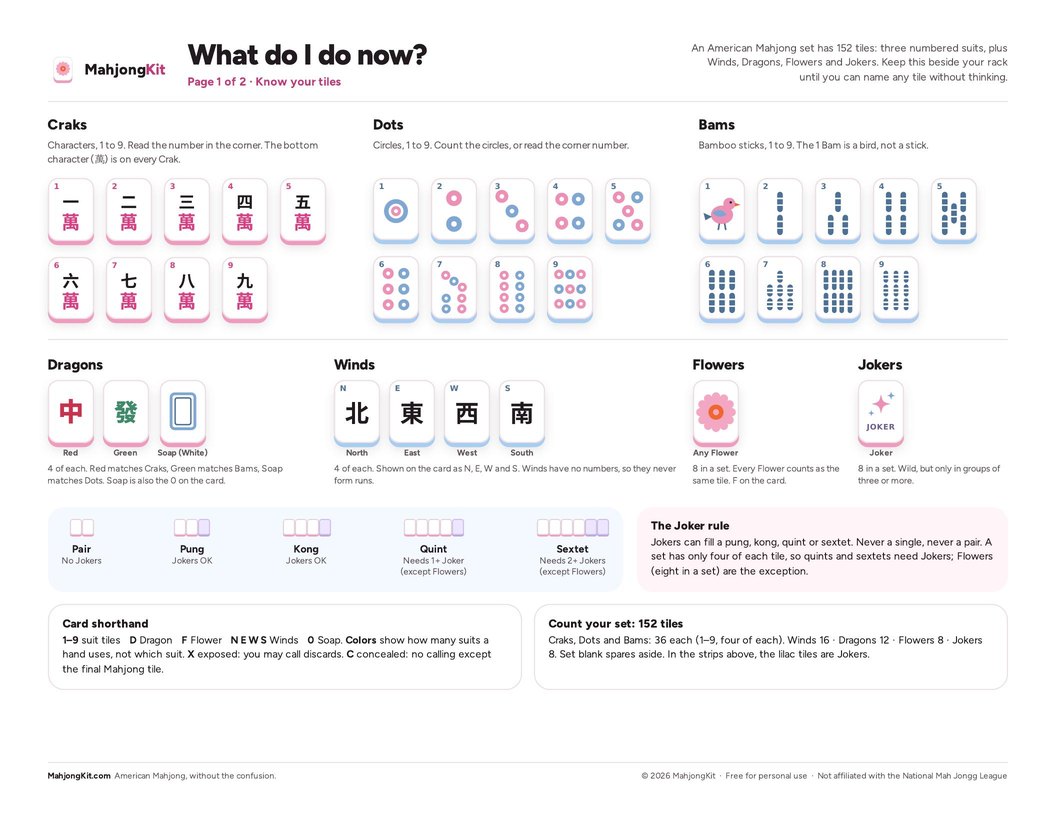
What do I do now? The table companion
Two letter-size pages to keep beside your rack: every tile with its name, and a top-to-bottom guide to what to do at each moment of a hand.